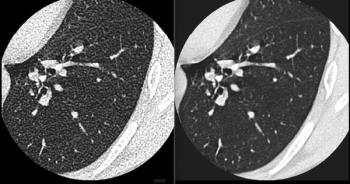
New research suggests that AI-enabled slab reconstruction technology, which reduces the number of images for interpretation with screening digital breast tomosynthesis (DBT), facilitates higher specificity and reduced abnormal interpretation rate (AIR) without affecting sensitivity and breast cancer detection rates.
For the retrospective study, recently published in Radiology, researchers reviewed data from a total of 119,662 screening DBT exams from a total of 64,949 women to evaluate the use of the slab reconstruction technology (3DQuorum, Hologic), which provides 6 mm synthetic slices with 3 mm overlap for DBT exams. The cohort was comprised of 52,649 women (mean age of 60) and 77,577 DBT exams completed prior to the use of slab reconstruction and a post-implementation population of 42,059 women (mean age of 60) who had a total of 42,085 DBT exams, according to the study.
The researchers found the use of the AI-powered slab reconstruction technology found no statistically significant differences in sensitivity (85.9 percent vs. 82.3 percent), cancer detection rate (6.5 per 1000 vs. 5.8 per 1000) nor false negative rates (1.1 per 1000 vs. 1.2 per 1000).
However, the study authors noted statistically significant improvements with the slab reconstruction technology with higher specificity (94.9 percent vs. 94.4 percent) and a lower abnormal interpretation rate (AIR) (5.8 percent vs. 6.2 percent).
In a 2025 interview with Diagnostic Imaging at the RSNA conference, lead study author Manisha Bahl, MD, MPH, FSBI, highlighted the impact of slab reconstruction technology upon recall rates.
“ … Our recall rate was actually lower after the implementation of 3DQuorum, and our specificity was higher, suggesting that we're better able to distinguish benign from malignant findings with this technology,” observed Dr. Bahl, an associate professor of radiology at Harvard Medical School and a breast radiologist affiliated with Massachusetts General Hospital.
Noting that the majority of the women in the study were 50 years of age and older, the study authors found in subgroup analyses no discernable differences in performance metrics with slab reconstruction technology in women under 50 years of age.
Three Key Takeaways
• Maintained diagnostic accuracy. AI-enabled slab reconstruction technology (3DQuorum) did not compromise sensitivity or cancer detection rates in screening DBT, with no statistically significant differences found in sensitivity (85.9 percent vs. 82.3 percent), cancer detection rate (6.5 vs. 5.8 per 1,000), or false negative rates between pre- and post-implementation cohorts.
• Improved specificity and lower recall rates. Implementation of the slab reconstruction technology yielded statistically significant improvements in specificity (94.9 percent vs. 94.4 percent) and a reduced abnormal interpretation rate (5.8 percent vs. 6.2 percent), suggesting the technology better enables radiologists to distinguish benign from malignant findings, and may help reduce unnecessary patient callbacks.
• Benefits may be population-specific. Subgroup analyses indicated that the gains in specificity and AIR reduction were most pronounced in women with scattered fibroglandular breast density and were not observed in women under 50 years of age. Generalizability may also be limited given the predominantly White cohort (~80%), low representation of women with extremely dense breasts (~3%), single-center design, and use of subspecialized breast radiologists with extensive DBT experience.
With respect to breast density, the researchers found that the statistically significant reduction in AIR and higher specificity with slab reconstruction only occurred in women with scattered fibroglandular density.
“These findings suggest that the benefits of slab reconstruction are more pronounced in older women and those with scattered fibroglandular densities,” added Bahl and colleagues.
(Editor’s note: For related content, see “Mammography Study: Can Slab Reconstruction Technology Reinvent Efficiency with DBT?,” “Can Adjunctive AI Enhance DBT Detection of Invasive Lobular Cancer?” and “Can AI Detect Breast Cancer on DBT Years Earlier than Radiologists?”)
Beyond the inherent limitations of a single-center, retrospective study, the authors acknowledged that approximately 80 percent of the cohort was comprised of White women and approximately 3 percent of the cohort had extremely dense breasts. The researchers also noted the use of a single vendor for the slab reconstruction technology and that image interpretation was performed by subspecialized breast radiologists who had extensive experience with DBT.