








Report claims ultrasound will buck economic trendClear Image, Siemens join forces for panel protectionGE, Medipattern extend alliance GE presses low-dose CT
Report claims ultrasound will buck economic trendClear Image, Siemens join forces for panel protectionGE, Medipattern extend alliance GE presses low-dose CT
A new endovascular sonic lysis system reduces thrombolytic dosage for treating peripheral thrombi while lessening the risk of hemorrhage by dissolving clots in as little as 12 hours, according to a report from southern Florida interventionalists at the 2009 International Symposium on Endovascular Therapy held last week in Hollywood, FL.
Pro Medicus acquires Visage ImagingToshiba licenses harmonic imaging patentFluoroPharma gains access to new patentVirtual Radiologic welcomes new CEOIDC founder steps down
Chinese ultrasound maker reports strong 4Q growthStereotaxis reports advanced interventionMerge pulls back on Chinese divestiture
Investors reward Varian 1Q growthSonoSite forecasts revenue gains
Hologic profit outlook brightens amid lower revenuesSonoSite releases breast imaging unit
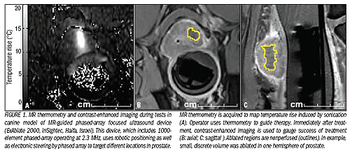
Prostate cancer is a leading cause of cancer death inU.S. men, second only to lung cancer. During2008, an estimated 186,320 new cases of prostatecancer will be diagnosed in the U.S.
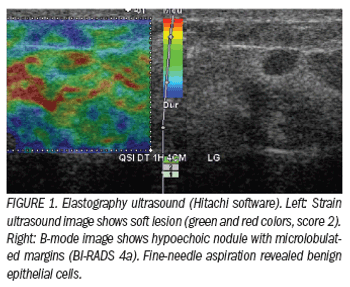
Ultrasound has long been an efficient and usefuladjunct technique for breast imaging. It is thefirst modality to be proposed in some situations:if a young or pregnant woman has a palpablemass, for example, or immediately after surgery.
Efforts to raise awareness about the associated risks of CT-based radiation exposure and the need to keep children from receiving unnecessary scans seem to be achieving traction among healthcare providers, according to a study by Ohio researchers. Their findings suggest that such increased awareness may make referring physicians less likely to order imaging that involves ionizing radiation for young patients.
Researchers from Austria, Italy, and Egypt are taking a leap of faith to evaluate several possible ultrasound elastography applications in musculoskeletal radiology. Everyone from weekend warriors to elite athletes may benefit if the test is proven effective, according to papers released at the 2008 RSNA meeting.
High-resolution sonography can accurately detect the causes of residual limb pain in amputees, according to British researchers, who found that ultrasound can guide proper treatment and rehabilitation, help educate patients about their condition, and even help with design and fitting of prostheses.
Candelis adds mammo module to ITFonar continues to tradeAlliance extends Fujifilm servicesInfinitt unveils fusion tool setSonoSite introduces gynecology scanner
Siemens debuts breast ultrasound scannerSiemens dedicates MR scanner to breastFujifilm acquires RIS firmFujifilm unveils flat-panel DRNuance enhances decision support
Educational efforts to raise awareness about the associated risks of CT-based radiation exposure and the need to keep children from receiving unnecessary scans seem to be achieving traction among healthcare providers, according to a study by Ohio researchers. Their findings suggest that such increased awareness may make referring physicians less likely to order imaging that involves ionizing radiation for young patients.
Educational efforts to raise awareness about the associated risks of CT-based radiation exposure and the need to keep children from receiving unnecessary scans seem to be achieving traction among healthcare providers, according to a study by Ohio researchers. Their findings suggest that such increased awareness may make referring physicians less likely to order imaging that involves ionizing radiation for young patients.
Educational efforts to raise awareness about the associated risks of CT-based radiation exposure and the need to keep children from receiving unnecessary scans seem to be achieving traction among healthcare providers, according to a study by Ohio researchers. Their findings suggest that such increased awareness may make referring physicians less likely to order imaging that involves ionizing radiation for young patients.
Siemens debuts breast ultrasound scannerSiemens dedicates MR scanner to breastFujifilm acquires RIS firmFujifilm unveils flat-panel DRNuance enhances decision support
Siemens Healthcare unveiled a breast ultrasound system at RSNA 2008 whose automated exams could help women’s health practitioners achieve the potential of ultrasound as a complement to mammography.
GE Healthcare combined ultrasound scanner controls and real-time imaging on a single display with the integration of a touchscreen monitor into its compact Logiq e product.
Automated breast ultrasound should not replace handheld ultrasound in a diagnostic breast center but rather should be used in conjunction with it or play a role in screening breast ultrasound, according to a study presented at the 2008 RSNA meeting.
The latest development in ultrasound from GE Healthcare, its Logiq E9, promises to tap the modality’s true diagnostic potential while exceeding that of ultrasound alone to provide interventional guidance. The ability to merge data from CT and other modalities into a live ultrasound scan distinguishes this new scanner, which began commercial deliveries in September.
GE launches new digital XR systemsPhilips unveils new 16-slice CTDigital stereotaxy adds to GE digital mammoTouchscreen enhances GE compact ultrasound
The news was mixed for CT in the emergency department in research presented Wednesday at the RSNA meeting. CT was found to be better than ultrasound for diagnosing ER patients with abdominal pain, but radiation dose can be drastically reduced for patients suspected of appendicitis, according to authors of several studies.
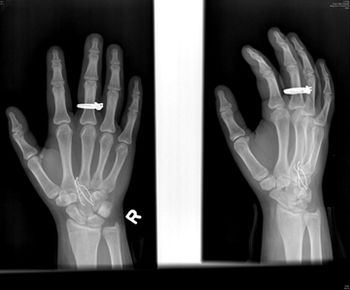
A new kind of self-mutilation is creeping into the teenage population, one that involves inserting objects into the body, according to radiologist Dr. William E. Shiels, II, who presented the first study of the adolescent phenomenon at the RSNA conference Wednesday.
Toshiba America Medical Systems has positioned its MicroPure ultrasound technology as a way to better characterize microcalcifications. The new technology, showcased at RSNA 2008 on Toshiba’s Aplio XG ultrasound scanner, improves the detection of small calcifications that otherwise may evade detection with ultrasound.