Canon Medical Systems offer a range of in-person and virtual educational opportunities for their clients.

Canon Medical Systems offer a range of in-person and virtual educational opportunities for their clients.

In a video interview, Morris Panner, the president of Intelerad Medical Systems, discussed key observations from the recent Society for Imaging Informatics in Medicine (SIIM) conference, recent research about artificial intelligence (AI) adoption and emerging goals for enhancing the efficiency of radiology workflows.

In a video interview, Jonathan Dillman, MD, MSc discussed a recently published statement from the American College of Radiology (ACR) that questioned the literature support for a March guidance from the Food and Drug Administration (FDA) about thyroid monitoring for children three years of age or younger within three weeks of exposure to iodinated contrast media (ICM).

In a recent video interview, neurologist Pardis Zarifkar, MD discussed a new study that found significantly elevated risks for Alzheimer’s disease and Parkinson’s disease among patients who tested positive for COVID-19.

In a recent video interview, abdominal radiologist Sonia Gupta, MD discussed key principles in assessing potential alliances with artificial intelligence (AI) vendors and the potential of AI to alleviate the time-consuming, administrative aspects of patient care.

In a recent video interview, interventional radiologist Lindsay Machan, MD, discussed his longtime work with selective salpingography and fallopian tube recanalization to assist women with infertility issues, and key findings from a new study that he recently presented at the Society of Interventional Radiology (SIR) conference.

In a recent video interview on the current iodinated contrast media shortage, neuroradiologist Sean Bryant, MD discussed imaging alternatives, emphasized communication with referring physicians on optimal studies, and discussed the ongoing need to prevent “protocol creep” with timely updates of imaging protocols.

In a recent video interview, two radiology professors from the Yale School of Medicine discussed the impact of the iodinated contrast media (ICM) shortage and potential strategies, ranging from ICM dose reduction to possible deferment of non-urgent imaging, that may provide a viable path moving forward.

In recent video interviews, Syam Reddy, MD, Judy Yee, MD and Anand Narayan, MD, discussed various benefits of computed tomography colonography (CTC) for colorectal cancer screening, the underutilization of the CTC procedure and steps moving forward to improve access to this procedure.

Sharing insights from their recent presentation at the American Roentgen Ray Society (ARRS) conference in a new video interview, researchers discussed how sex-based differences have an impact in the imaging and diagnosis of ischemic heart disease (IHD) in women.

In a recent video interview, Arun Krishnaraj, MD, MPH and David Larson, MD, MBA, discussed the continued use of physical media to transport medical images between different health-care facilities, resulting inefficiencies and delays with patient care, and the initiative to create a linked multi-hub model to end this dated practice once and for all.

In a recent video interview, Syam Reddy, MD discussed the merits of computed tomography (CT) colonography, a non-invasive alternative to conventional colonoscopy, which may help reduce gaps in screening for colorectal cancer.

In a recent video interview, Kevin J. Abrams, MD, discussed highlights from the recent 25th Annual Symposium of the American Society of Spine Radiology (ASSR), including lectures on imaging for spontaneous intracranial hypotension, the emergence of dynamic susceptibility contrast for MR perfusion and insights on the use of dual-energy computed tomography (CT) for diagnosing vertebral fractures.

In a recent video interview, Amy K. Patel, MD, discussed the aftereffects of delayed breast cancer screening due to the COVID-19 pandemic, keys for improving outreach to underserved communities, legislative wins and challenges, and coalition building to educate and encourage women to resume regular breast cancer screening exams.

Innovations with artificial technology (AI) are fueling product advances that offer enhanced image quality, patient positioning and workflow efficiencies.

In a recent video interview, Nina Kottler, MD, discussed the promise of artificial intelligence (AI) for improving workflow efficiency for radiologists, keys to assessing AI vendors and change management principles for facilitating implementation of AI into one’s practice.

In a new video presentation, a neuroradiologist discusses steps that individual radiologists can take to reduce the risk of physician burnout as well as actions that group radiology practices can take to increase the engagement of their staff.

The portability and durability of the device may make it an emerging option for bedside imaging.

In an exclusive video interview with Diagnostic Imaging, Josh Cooper, vice president of congressional affairs for the American College of Radiology (ACR), and Thomas Hoffman, vice president of legal for the ACR, discuss the ACR’s lawsuit over the IDR process of the No Surprises Act and the potential impact of the law on reimbursement and patient access to care.

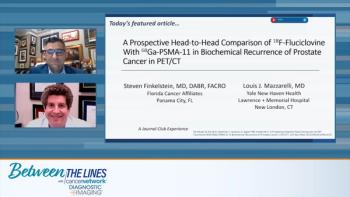
Interesting questions raised by a paper that compared the use of 18F-fluciclovine with 68Ga-PSMA-11 imaging modalities to detect biochemical relapse in prostate cancer and implications for integrating newer techniques into clinical practice.

Reactions to key findings from an article by Birgit Pernthaler, et al, that compared the use of 18F-fluciclovine with 68Ga-PSMA-11 imaging modalities to detect biochemical relapse in prostate cancer.

Drs Steven Finkelstein and Louis J. Mazzarelli highlight data revealed in the article “A Prospective Head-to-Head Comparison of 18F-Fluciclovine With 68Ga-PSMA-11 in Biochemical Recurrence of Prostate Cancer in PET/CT,” by Birgit Pernthaler, et al.

During the pandemic and beyond, working from home as a radiologist can present clear work-life advantages.

Drs Steven Finkelstein and Louis J. Mazzarelli comment on limitations associated with conventional imaging modalities in prostate cancer and highlight the roles of newer tests such as 18F-fluciclovine and 68Ga-PSMA-11.

Canon's latest entry into the PET/CT market is a digital, air-cooled system that provides customizable solutions for a range of clients.

Learn more about what Canon Medical will be showcasing virtually at RSNA 2021.

The work of a breast imager goes far beyond the pink-out of every October.

Diagnostic Imaging sat down with medical physicist and CT expert Cynthia H. McCollough, PhD, to learn more about the history of CT and its expanding potential in medical imaging.

When it comes to improving radiology understanding and performance, there’s a shift underway from peer review to peer learning.

This partnership opens the door to better access to data for AI tools, as well as streamlined workflow, augments physician training, and better patient care.